The Photographer's Guide to a London Night
Short answer. Shoot in the hour after civil dusk, not at midnight — the sky still separates the buildings from it. Stand on Waterloo Bridge, the Millennium Bridge and the south end of Westminster Bridge. Bring a tripod, because light trails are the shot that needs one and a phone cannot fake it.
The hour that matters
Almost every good photograph of London at night was taken in the same window: the hour after civil dusk. The floodlighting is already on, the sky still holds enough blue to separate the buildings from it, and the exposure balance between the two is workable without a fight.
An hour later the sky is black and flat, the lit facades blow out against it, and the same composition is measurably harder. The practical consequence is that your ideal departure time changes by five hours across the year.
| Month | Civil dusk | Be on the bridge at | Which departure |
|---|---|---|---|
| December | 16:32 | 16:30 | The 7.30pm, or go alone earlier |
| March | 18:38 | 18:35 | The 7.30pm |
| June | 22:07 | 22:05 | The 10.15pm, or go alone |
| September | 19:50 | 19:45 | The 7.30pm |
The month-by-month page has the dusk time for every month, and it is the single most useful planning tool here for a photographer.
Where to stand
- Waterloo Bridge. The best single vantage point in London: the City one way, Westminster the other, and no charge for either.
- The Millennium Bridge. Frames the dome of St Paul's dead centre. Go late and there is nobody on it.
- The south end of Westminster Bridge. The Houses of Parliament straight on, with the river in front.
- Golden Jubilee Bridges. Elevated, and the only place you get the London Eye and Westminster in one frame from above the water.
- The terrace outside Tate Modern. Free, open, and facing St Paul's across the river.
All five are on the stretch of river covered by the Illuminated River commission, which is not a coincidence: that scheme was designed to be looked at.
What to bring
A tripod. This is the accessory that changes what you come home with, because light trails and smooth water are exposures of several seconds and nothing handheld will do it. One reviewer of the night photography walk specifically mentions hiring one from the operator, which is worth knowing if you are travelling light.
A spare battery. Cold drains them faster than you expect and a London December evening is cold.
More memory than you think. Bracketing three exposures per composition across two hours adds up quickly.
Gloves you can work in. Standing still on a bridge in January with bare hands on a metal tripod is a short experience.
Useful tip. If you are travelling without a tripod, the night photography operator hires them out on request after booking. One reviewer specifically mentions doing exactly that. The format page has the detail.
Settings, briefly
This is not a camera manual, but three things cover most of it. Shoot at the lowest ISO your exposure allows, because noise in the dark areas is what separates an amateur night shot from a good one. Use a small aperture around f/8 to f/11 if you want the streetlights to render as stars. And let the shutter run — two to fifteen seconds is the working range for light trails, and the buses on Westminster Bridge come past often enough that you will get several attempts.
Shooting from a moving bus
Difficult, and worth setting expectations about. An open-top bus is the hardest platform on this market. You are moving, the deck vibrates, and you cannot choose where to stop. A phone in night mode will produce something; a long exposure will produce a smear.
If photographs are the reason you are going out, book a format that stops. The private black cab tours stop wherever you ask, and the dedicated photography walk stops at eight riverside viewpoints in three hours.
Is the guided photography walk worth it?
It depends entirely on where you are starting. The listing runs three hours along the South Bank with a professional fine-art photographer, private to your own party, geared to whatever camera you actually own, and it finishes with a review of your images.
Reviewers who arrived with some experience describe it as the best evening of their trip. One who had bought his first SLR the week before says plainly that he was underprepared and still learned a great deal. That is a fair description of the level: transformative if you know your camera a little, generous if you do not.
Did you know? Wet roads are the condition photographers actively want, because every light in the city appears twice. The weather page covers what rain does and does not stop.
One frame worth planning for
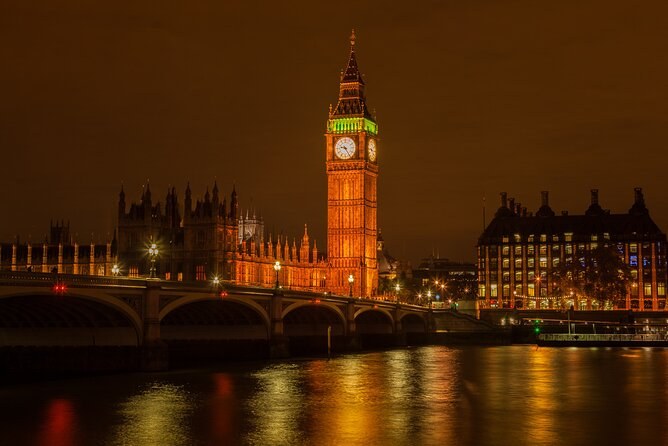
If you take a single photograph in London after dark, make it a long exposure from Westminster Bridge looking north. The Houses of Parliament fill the right of the frame and the river carries the reflection down the middle. The buses crossing behind you leave red trails through the foreground. Eight seconds at f/11 is a reasonable place to start.
Go on a wet evening if you can. The road surface doubles every light in the shot, and the whole frame gains a depth a dry night simply does not have.
What to do with them afterwards
Night photographs need less work than daylight ones and a different kind of it. The two adjustments that do most of the lifting are pulling the highlights down — floodlit stone blows out easily and recovering it is what separates a usable frame from a white shape — and lifting the shadows just enough to keep detail in the buildings that are not lit.
Resist the temptation to push the saturation. London's night lighting is already a strong colour: sodium orange on the older streets, cold white on the newer ones, and the shifting blues and greens of the river commission. Increase it and the whole thing tips into something that looks like a screensaver.
White balance is the one genuine judgement call. Set it neutral and the sodium light reads orange, which is honest and is what your eye saw. Cool it down and the image reads more like the brochure and less like the evening. Neither is wrong; pick one and apply it across the set so the pictures look like a night rather than a collection.
The free version
Waterloo Bridge at dusk, east along the South Bank to Tower Bridge, back on the north side. Two hours, no cost, and it passes almost every composition in this article. If you are confident with a tripod and a map, this is the whole guide. The route is written out in full.
What you do not get is somebody telling you why the shot is not working while there is still time to fix it, which on a single trip is most of what tuition is for.
What next
Bring the tripod. London Night Tours lists every departure, and what to expect covers photographing from each format.
Departures that stop long enough to photograph
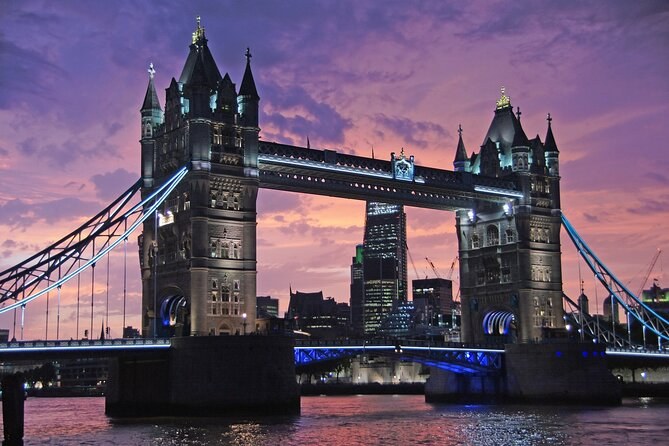
Private Panoramic London Night Tour
Private groupTransport includedGuide included
From $247 per person