London Night Facts That Surprise First-Time Visitors
Short answer. London gets no true astronomical darkness for about seven weeks a year, the Night Tube runs on two nights out of seven, and a small lamp above the Elizabeth Tower clock tells you whether Parliament is still sitting. None of these is on a postcard and all three change how you plan an evening.
For seven weeks a year it never gets properly dark
London sits at 51.5 degrees north, and between roughly late May and mid-July the sun never drops the eighteen degrees below the horizon that astronomical darkness requires. Mid-June nautical dusk is 23:21 and the sky does not get blacker than that — it keeps a blue cast all night.
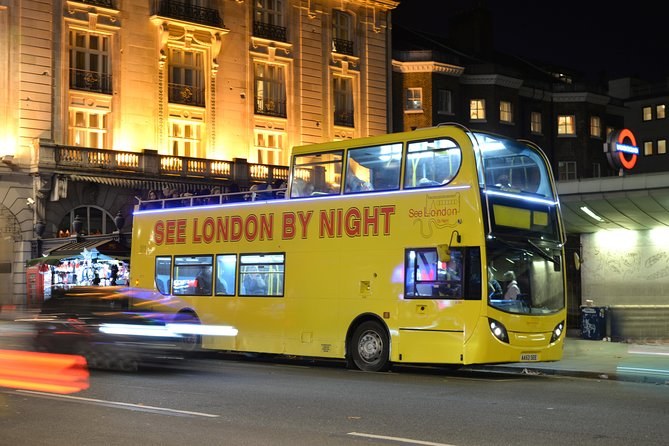
This is genuinely lovely and it is not the sky in the photographs that sold you the idea. It is also why both open-top operators warn in their own small print that summer departures run mainly in daylight. The month-by-month page has the figures.
A lamp tells you whether Parliament is sitting
Above the four clock faces of the Elizabeth Tower there is a small lantern known as the Ayrton Light. It burns when either House is still sitting after dark, and goes out when they rise.
It is the only part of London's night lighting that changes from one evening to the next, and it means the most photographed building in the country is quietly broadcasting its own status to anybody who knows to look up. Almost nobody does.
Did you know? The Ayrton Light was installed so that Queen Victoria could see from Buckingham Palace whether Parliament was still sitting. It still does the same job for anybody who looks up. More on what is lit here.
The Night Tube runs two nights a week, not seven
Visitors reliably assume the Underground runs all night in a city this size. It runs all night on Friday and Saturday only, and only on five lines: Central, Jubilee, Northern, Piccadilly and Victoria.
Sunday to Thursday the answer is the night bus network, which does run every night, all night, everywhere. It is not an open-top bus and it is a great deal cheaper. That is a better system than most cities have, and it is nobody's first guess. The planning page covers getting home.
Nine bridges are a single artwork
The Illuminated River is a permanent light commission covering nine central Thames crossings, and the colours move slowly across each span rather than sitting still. It is not floodlighting and it is not decoration — it is one work spread over about two and a half miles of river.
One black cab tour is built entirely around it. Most visitors walk over three of the nine without realising they are inside a piece of art.
The clocks move sunset by a full hour overnight
British Summer Time ends on 25 October 2026 and begins on 29 March 2026. On both dates sunset jumps by a full hour between one evening and the next.
The practical effect is sharper than it sounds: a late-October evening that was daylight last week is dark this week, and a late-March evening that was dark last week is not. If your dates straddle either changeover, check which side of it you are on before you book a departure time.
| Date | What changes | What it means for you |
|---|---|---|
| 29 March 2026 | Clocks go forward | Sunset jumps to about 19:28 overnight |
| Late May – mid-July | No astronomical darkness | The sky keeps a blue cast all night |
| 26 June | Latest sunset, 21:22 | Only the last departure runs in the dark |
| 25 October 2026 | Clocks go back | Sunset drops to about 16:47 overnight |
| 12 December | Earliest sunset, 15:51 | Dark by four in the afternoon |
The cheapest thing here is also the most reviewed
Across this market the product with the most reviews by a factor of four is also the cheapest. That is not the usual shape of a tourist market, where price and popularity tend to move together, and it says something about what people actually want after dark in this city: a good story, told well, on foot.
Almost nothing is open, and that is the point
The Tower, the Abbey, the state rooms and the galleries all close in the late afternoon. There is effectively no such thing as visiting a London attraction at night, with the honourable exception of the observation decks and the theatres.
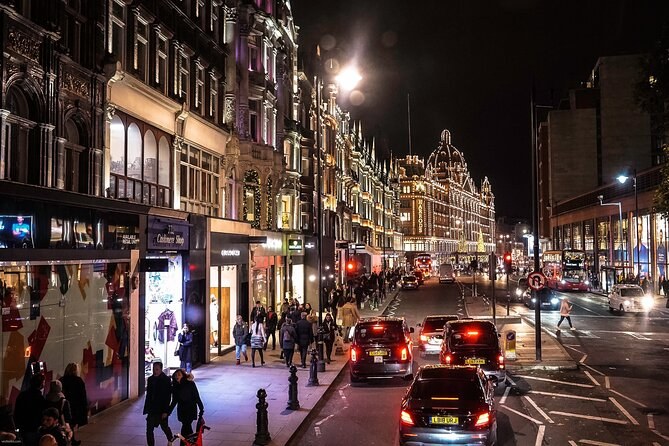
Which means a night tour of London is an outdoors, look-up experience by definition rather than by compromise. Once you stop expecting to go inside anything, the evening gets a great deal better. The attractions page says what is lit and what is shut.
Useful tip. If you want the sky genuinely black rather than deep blue, come between October and March. The month-by-month page is the fastest way to check your dates.
The night bus network is bigger than the Tube
London runs a full parallel bus network overnight, every night, across the whole city. Routes carry an N prefix and they go where the day buses go, which means that at three in the morning on a Tuesday you can cross London for the price of a single fare from a stop you can see from wherever you are standing.
Visitors almost never use it, partly because it is invisible unless somebody tells you and partly because the Night Tube gets all the attention despite running two nights a week. If your evening finishes late and it is not a Friday or Saturday, this is the answer, and it is a considerably better one than most cities offer.
Wet roads are what the photographers want
Rain is treated as the enemy of an evening out and for photography it is the opposite. A wet road doubles every light in the city, and the long exposures that make London look like the brochure depend on it.
The walking tours run in all weathers and say so, the buses keep an enclosed lower deck, and the cabs are cabs. There is very little weather in this city that cancels an evening. The photography guide has more.
The taxi drivers really did memorise the city
The Knowledge is the examination London taxi drivers sit to be licensed, covering the street layout of the whole of central London from memory. It takes years.
On a night tour that stops being trivia and becomes the product: it is why a cab tour can change its route halfway through on your say-so without anybody consulting a map, and why reviewers of these tours name their drivers as often as they name the landmarks. The black cab page explains what that buys.
What next
Facts are better in person. London Night Tours lists every departure, and the attractions page says what each one shows you.
Evenings built on the things above