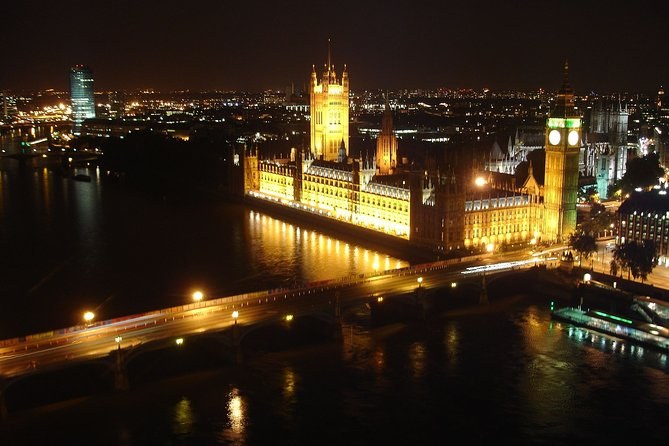
London by Night Sightseeing Open Top Bus Tour with Live Guide
Live guide12 audio languagesMax 72
From $39 per person
The instinct is to read these two as a cheap option and an expensive one. They are not. A bus seat buys you coverage: the widest sweep of floodlit London available in ninety minutes. A private cab buys you control: the route, the pace, the stops, and a guide talking only to you.
Once you see them that way the price gap stops being outrageous and starts being a question about what you want the evening to be.
| Open-top bus | Private black cab | |
|---|---|---|
| Price | $39 per person | $547 per vehicle, up to 6 |
| Length | 1 hour 30 | 4 hours |
| Stops | None — one continuous loop | Wherever you ask |
| Pickup | You go to the stop | From your own hotel |
| Warm? | Not on the top deck | Yes |
| Accessible | Listed as not accessible | Listed as accessible |
| Best for | Couples, first visits, short stays | Groups of four to six |
A bus seat is $39. A four-hour private cab is $547 for the vehicle, up to six people. Divide it and the crossover is straightforward:
The strict break-even is around fourteen people, which no cab can carry. The useful crossover is far lower, because at four or more you are no longer comparing like with like: you are comparing ninety passive minutes with four active ones.
It is the right first evening in London. If you have two nights and a list of things you have only seen in photographs, ninety minutes on an open top deck covers more of them than anything else at this price. Buckingham Palace, Westminster, the London Eye, St Paul's and the Tower are all on the circuit.
It is also the easiest booking on the market. Pick a departure point on an open-top bus, turn up and sit down. A live guide travels with the bus and audio guides cover twelve languages on one of the two routes. London night bus tours compares the two open-top bus routes against each other.
Nobody has to find a meeting point. Your driver collects you from your own hotel, texts when he arrives, and takes four hours over nine landmarks with time to get out at each one. He has passed the Knowledge, so changing the plan halfway through costs nothing.
It is also the accessible option. The cab listings describe the vehicle, the surfaces and the transport as wheelchair accessible and one carries infant seats; both open-top routes state that they are not accessible. The black cab page has the detail.
An open top deck at twenty miles an hour in December is colder than the pavement outside your hotel, and the single commonest criticism across both bus routes is not the tour but the temperature. It is entirely solvable — a hat, gloves and one more layer — but it has to be solved before you leave.
A cab has heating. On a January evening with a family, that is not a small consideration, and it is the reason the two formats sell to different people in winter than in summer.
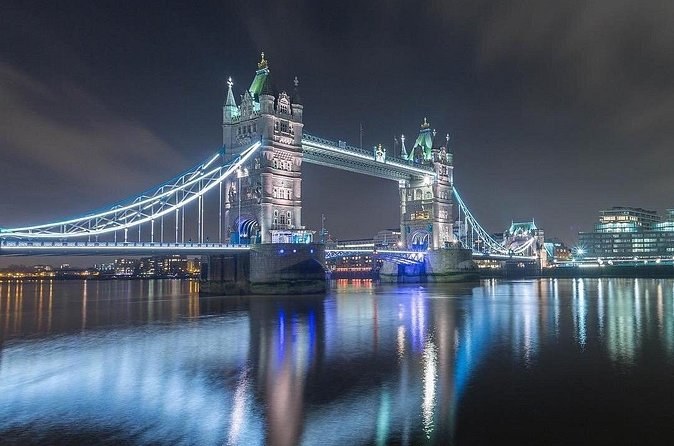
The bus cannot stop. This is a single circuit rather than a hop-on hop-off ticket, and there is no rejoining it. If you want to stand in front of Tower Bridge, this is not the format.
The cab cannot be cheap for two. There is no version of the arithmetic where a couple is better off in a private vehicle, unless comfort or access is worth the difference to you — which for some travellers it straightforwardly is.
Framing this as bus against cab hides a third answer that suits a lot of people better than either: a walking tour. It costs less than a bus seat, it lasts longer than the bus circuit, and it goes places neither vehicle can reach. What it does not do is cover the city — a walk is one district, told properly, and if your list is Buckingham Palace and the Tower and St Paul's then walking is not the tool.
There is also a version of the cab argument that has nothing to do with money. The private vehicle is the only format on this market that will collect a traveller with limited mobility from their hotel door, and both open-top routes state that they are not wheelchair accessible. Where access is the constraint the arithmetic stops mattering, because there is only one option that works.
And there is the weather. In July the difference between an open top deck and an enclosed cab is a preference. In January it decides whether anybody enjoys the evening, and it is the reason these two formats sell to different people in different seasons rather than competing head-on all year.
If neither of these is quite it, the format page covers the walking tours and the photography walk as well.
Two formats, one decision. Compare both against everything else on London Night Tours, or read what a night tour costs for the full price picture.
From $39 per person
From $356 per group (up to 6)