Seeing a London Night Without a Tour
Short answer. Most of what a ninety-minute bus circuit shows you is a free walk along the river, and the night buses cover the same roads for a fare. Here is the route in full, and an honest account of what you give up by doing it alone.
Do you need a tour at all?
Often, no. London after dark is one of the easiest cities in the world to see without help: the landmarks are floodlit and free to look at, the best stretch of them is a continuous riverside walk, and the whole thing is well lit and busy until late.
What a tour adds is commentary, a route somebody else has optimised, and on the walking tours a subject you would not find alone. Whether that is worth $27 or $547 depends entirely on which of the three you actually want, and this page is written to help you decide against booking if that is the right answer.
| What you want | Do it yourself | Book something |
|---|---|---|
| The floodlit river | Waterloo Bridge to Tower Bridge, free | Not necessary |
| Commentary and history | A podcast, badly | Yes — this is the whole product |
| The East End after dark | Possible, but you will miss it | Yes, strongly |
| Covering the whole city fast | Night bus route 15, roughly | The open-top bus |
| Door-to-door comfort | A taxi with no commentary | A private cab tour |
| Learning night photography | YouTube and practice | The photography walk |
The walk that replaces a bus circuit
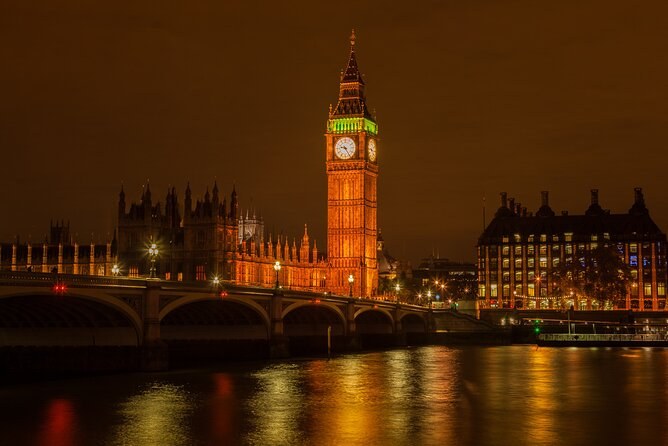
Start on Westminster Bridge, south side, an hour after civil dusk. The Houses of Parliament are straight in front of you, floodlit, with the river carrying the reflection the full width.
Walk east along the South Bank. You pass the London Eye, the Royal Festival Hall, the Golden Jubilee Bridges, Tate Modern, Shakespeare's Globe and Borough Market in about fifty minutes at an easy pace. Cross at Tower Bridge, come back along the north side past the Tower of London and St Paul's, and finish on Waterloo Bridge.
That is roughly two and a half hours, it is free, and it covers most of what the bus routes cover. The attractions page says what each thing looks like lit.
What is the Illuminated River?
The Illuminated River is a permanent light commission across nine central Thames crossings, and the reason the walk above is better than the sum of its landmarks. The colours move slowly along each span rather than sitting still, so the river reads as one continuous work rather than a row of lit objects.
Blackfriars and the Millennium Bridge are the two best places to stand and watch it. Nobody charges for this and most visitors walk over three of the nine without knowing they are inside a piece of art.
Can you do it by night bus?
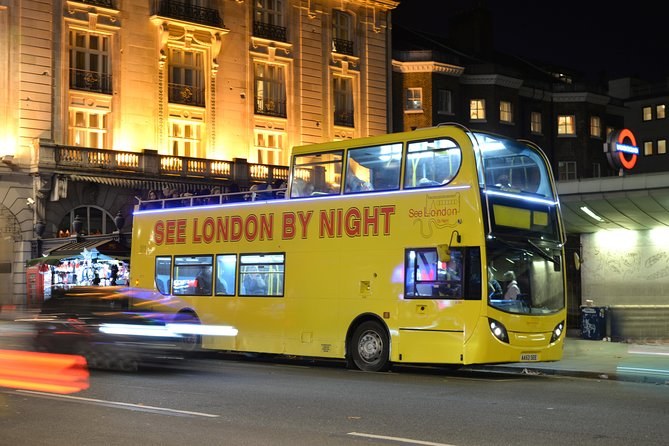
Yes, and it is the cheapest guided-ish tour in London. Night buses run every night, all night, across the whole network, and several routes cross the centre past most of what a sightseeing bus passes. You get the top deck, the windows and the city; you do not get a guide or an open roof.
The obvious catch is that a night bus goes where it goes. You are choosing between a route somebody designed for sightseeing and a route somebody designed for getting people home, and the second one is considerably cheaper.
Did you know? The walk from Waterloo Bridge to Tower Bridge and back covers most of what a ninety-minute bus circuit shows you, for nothing. What is lit, building by building.
Where should you stand?
- Waterloo Bridge — the City one way, Westminster the other. The best single view in London and there is no charge for it.
- The Millennium Bridge — St Paul's dead centre, and empty after ten.
- The south end of Westminster Bridge — Parliament straight on across the water.
- The terrace outside Tate Modern — free, open, facing the dome.
- Golden Jubilee Bridges — elevated, and the only place you get the Eye and Westminster from above the water.
Is it safe to walk London at night?
The route above is busy, lit and well policed for its whole length, and thousands of people walk parts of it every evening. Keep your phone in your pocket rather than your hand and it is an ordinary walk.
Where that stops being true is the quieter streets away from the river — the East End lanes the Ripper walks use, and the unlit park paths. Those are the places where a guide is genuinely worth the money, and it is not a coincidence that the guided walks go exactly there.
What do you actually give up?
The commentary. On a first visit this is most of the value. Nobody tells you that the small lamp above the Elizabeth Tower clock means Parliament is still sitting, and you will not find that out by looking at it.
The route somebody optimised. The bus circuits cover Knightsbridge, Harrods and the Royal Albert Hall, none of which is on the river and all of which take real effort to reach on foot.
The parts you cannot walk to. Battersea Power Station is on one cab route and is a forty-minute walk from anywhere you would otherwise be.
Useful tip. If you are doing it yourself, go out an hour after civil dusk rather than at ten. The sky still separates the buildings from itself. Dusk times for every month.
When is booking clearly the better call?
Four situations, and they are worth naming plainly. If it is your first visit and you have one evening, a guide gives you the city in ninety minutes rather than in a week. If you want the East End, book it. If there are five or six of you, a private cab is cheap per head and warm. And if mobility is a factor, the walk above is not the option — the cab tours are, and their listings say so.
The decision guide works through the rest.
What does a guide actually add?
Three things, and it is worth being precise about them because two are replaceable and one is not.
The first is facts, and you can get those from a book. The second is route, and you can get that from this page. The third is the thing that cannot be replaced: somebody answering the question you actually have, in the place you are standing, at the moment you think of it. On the walking tours in particular, the reviews are almost entirely about the guide rather than the streets.
That is why the cheapest products on this market are the ones with the highest review volumes. You are not paying for access to anything — every street on every one of these routes is public and free — you are paying for a person.
Is a self-guided night walk safe in winter?
On the river route, yes, and the qualifier matters more than the answer. The South Bank between Westminster and Tower Bridge is busy, lit and populated until late every night of the year, including in January, and thousands of people walk parts of it every evening.
What changes in winter is the hour rather than the risk. Dark at four means you are walking in the dark at six with the commuter crowds still out, which is if anything easier than walking the same route at ten in July when it has just emptied.
Keep your phone in your pocket rather than your hand, stay on the riverside path rather than cutting inland, and it is an ordinary walk. The streets where that advice stops being enough are the ones the guided walks go to, which is not a coincidence.
The one thing you cannot do alone
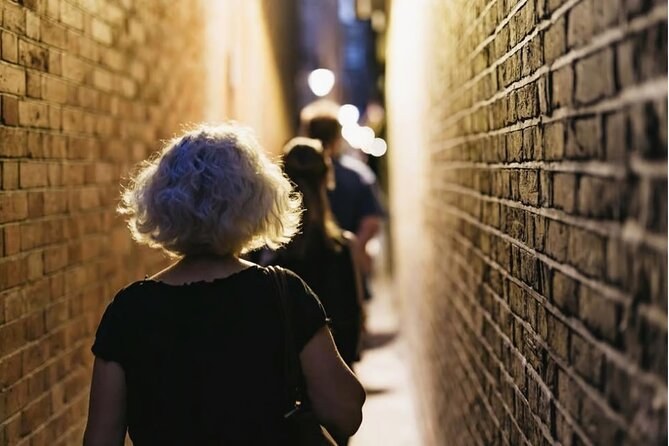
The East End. Whitechapel and Spitalfields after dark are not dangerous in any meaningful sense, but they are illegible: there is nothing floodlit, nothing signposted and nothing to tell you that the doorway you just walked past matters.
Walking it alone gives you brick and sodium light. Walking it with somebody who knows which doorway is which gives you the reason the district is famous, and that is the single clearest case on this whole market where the money buys something the free version cannot approximate.
At under thirty dollars it is also the cheapest thing here, which makes the argument easy. If you take one paid evening in London after dark, take that one.
The middle option nobody mentions
Walk the river yourself, then book one short guided thing for the part you cannot do alone. A $27 Ripper walk after a free hour on the South Bank is a complete evening for the price of a couple of drinks, and it is the version this site would recommend to a repeat visitor.
It also gets you the guide where a guide is worth having, which is in the district where nothing is floodlit and the story is the only thing there.
What does it cost to do it yourself?
A travelcard and a coat. If you are already staying centrally, the river walk needs neither — it is a walk from your hotel and back, and the only money involved is whatever you stop for on the way.
The night bus version costs a single fare each way. Compared with $39 for a bus seat or $547 for a cab, that is the whole argument for the self-guided evening, and it is a good one for anybody who has been to London before.
The honest summary
If you have been to London before, walk it. If you have not, book something, and make it either the cheapest walk or the format that suits your group size. Either way, check the month first, because the free walk has exactly the same darkness problem in June that the paid one does.
What next
Walking it? The attractions page says what is lit. Booking after all, London Night Tours has every departure and the prices to compare.