London Christmas Lights Private Tour by Traditional Black Cab
Private groupHotel pickupGuide included
From $549 per group (up to 6)
The displays go up and switch on across early to mid November and come down in early January. That is roughly six weeks of full season, and the three Christmas products on this market are unbookable outside it.
Exact switch-on dates are announced each autumn and are not published far ahead, so nothing here asserts one. If you are visiting in the first half of November, check before you book; from late November to the end of December the whole city is lit.
| Street | What is up | Best on foot or by cab? | Busiest |
|---|---|---|---|
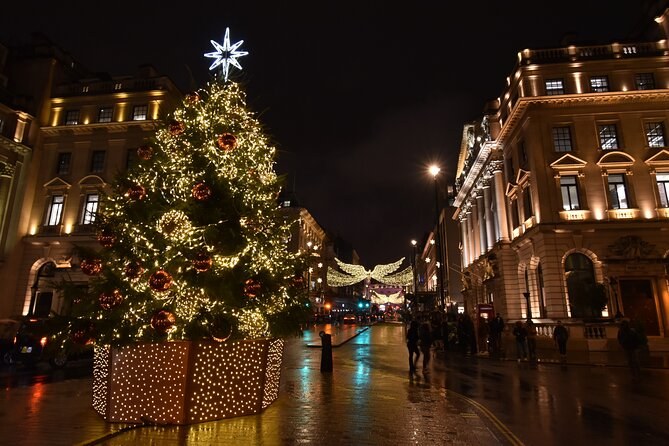
| Regent Street | The Spirit of Christmas angels, the full length | Either | Weekend afternoons |
| Oxford Street | The largest single display in the city | On foot | Late-night shopping |
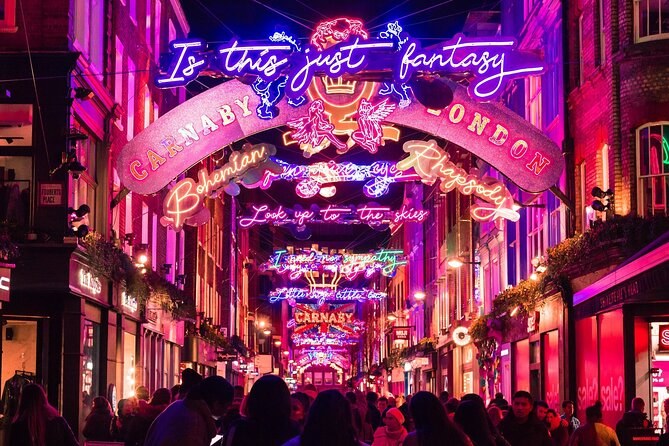
| Carnaby Street | A themed neon arch, different each year | On foot | Early evening |
| Covent Garden | The market hall, a reindeer and the giant baubles | On foot | All day |
| Bond and Davies Street | Snowflakes, and the Hedonism Wines display | Either | Evenings |
| Mayfair, Chelsea, Belgravia | Quieter, more expensive, less photographed | By cab | Rarely |
| Kensington | The Churchill Arms, the most decorated pub in London | By cab | Evenings |
Because the darkness and the display coincide. Sunset in mid-December is 15:52, the earliest of the year falls around the twelfth at 15:51, and civil dusk follows before half past four. The lights are on before most people have finished work.
Every other month of the year you are choosing between darkness and comfort. In December there is no trade — it is dark by four and the city has put on its best show. The month-by-month page has the rest.
Regent Street runs the Spirit of Christmas angels the full length of the street, and they are the ones people photograph. Oxford Street carries the largest single installation in the city. Carnaby Street does a themed neon arch that changes every year and is the least conventional of the three.
Covent Garden fills the market hall with oversized baubles and a lit reindeer outside it. Bond Street and Davies Street run snowflakes and the Hedonism Wines display. Mayfair, Chelsea, Belgravia and Kensington are quieter, more expensive and far less photographed, which is exactly why one cab route goes there instead.
Walk the West End, ride the rest. Covent Garden, Trafalgar Square, Piccadilly, Oxford Street, Carnaby Street and Regent Street form a loop you can do on foot in a couple of hours, and walking is the only way to get under the installations and photograph them properly.
Mayfair, Chelsea, Belgravia and Kensington do not form a loop and are a long way apart. That is a cab evening, and a black cab covers four neighbourhoods in two and a half hours because it can use bus lanes.
Guiding, and on the cab versions the vehicle. The walking version at $247 for up to ten people includes all guiding fees and a private guide; the cab versions at $413 and $547 include the taxi and a driver-guide, both for up to six.
What is excluded is worth reading: all three specifically exclude snacks, tea, coffee, anything alcoholic and gratuities. Eat before you go.
Further than anything else on this market. The season is six weeks long, the good evenings in the middle of December go first, and there is no second chance in the same trip. Book as soon as your dates are fixed.
Every one of these refunds in full up to 24 hours ahead, so an early booking costs nothing but a decision. The planning page has the general booking windows.
Entirely, and a lot of people should. The West End loop above is free, well lit, busy and completely walkable, and nobody stops you standing under the Regent Street angels for as long as you like.
What a tour adds is the quiet half of the city — the Mayfair and Kensington displays you would not know to look for — and a guide explaining where each one came from. The self-guided guide covers the free version properly.
They run on the South Bank, in Leicester Square and in several parks, and they overlap almost exactly with the lights season. None of the tours here includes market entry because none of the markets charges any.
The South Bank market sits directly on the walk between Westminster and Tower Bridge, which makes it the easy addition to an evening that was going that way anyway. More on the rest of the evening.
The walking tour is the better of the two for a family, because children can stop and look at things and there is no vehicle to sit still in. It takes up to ten people on one booking, which covers most families comfortably.
The cab versions are warmer, which in December counts for something, and one takes infants on laps rather than in seats. There are no booster seats in a London taxi, which is worth knowing before you book.
Oxford Street on a December Saturday is as crowded as central London gets all year. Weekday evenings are markedly better, and the quieter neighbourhoods are quiet even in peak week.
If crowds are the concern, the cab routes through Mayfair and Chelsea avoid the worst of it entirely, which is a genuine argument for the more expensive option rather than a sales one.
Tuesday or Wednesday, and it is not close. Oxford Street on a December Saturday is as crowded as central London gets in the whole year, and the difference between a weekend evening and a midweek one is the difference between shuffling and walking.
Thursday is the other one to avoid in the West End, because late-night shopping pulls the same crowd. Sunday evening is quieter than either but several of the shops behind the displays close early, which takes some of the life out of the streets.
If your dates are fixed and they land on a weekend, go earlier in the evening rather than later. The lights are on by half past four in December and the crowds do not really build until six.
A great deal, and most of it is free. Christmas markets run on the South Bank, in Leicester Square and in several of the parks, and none of them charges admission. The South Bank one sits directly on the walk between Westminster and Tower Bridge, which makes it the easy addition to a river evening.
The department store windows are their own attraction. Fortnum & Mason, Liberty and Harrods all commission displays and all of them are on a route somebody already runs. Harrods in particular is outlined in lights along its whole frontage and is on one of the bus circuits.
The ice rinks are the other December fixture, and they do charge. The after-dark page covers what else fills an evening.
Partly. The displays come down in early January, so the first week is usually still lit and the rest of the month is not. If your trip lands in that first week you get the lights with none of the December crowds, which is arguably the best combination available all season.
What January does have, reliably, is darkness. Sunset is 16:21 in mid-month and the skies are often the clearest of the winter, so the floodlit landmarks are at their best even with the shopping streets back to normal.
The Christmas products stop running once the displays are down, but everything else on this market runs year round and January is among the easiest months to book. The weather page has the figures.
Carnaby Street's arch is redesigned annually and is the one worth checking before you travel. Regent Street's angels and the Oxford Street installation are consistent from year to year, which is why they are the ones on every postcard.
Regent Street from the middle of the road at a crossing, looking down the length of it, so the angels recede into the distance. That is the shot, and it needs no equipment beyond a phone held steady.
Carnaby Street rewards standing directly underneath the arch and shooting upward. Covent Garden's market hall is the hardest of the three because the interior lighting fights the display, and the reindeer outside is easier than anything inside.
Come in December, walk the West End loop yourself, and book a cab for the neighbourhoods you would never find. Book it in October. Every departure refunds in full a day ahead, so there is no risk in deciding early.
The season is short. London Night Tours has every Christmas departure, and the December darkness figures explain why this month is the one.
From $549 per group (up to 6)